
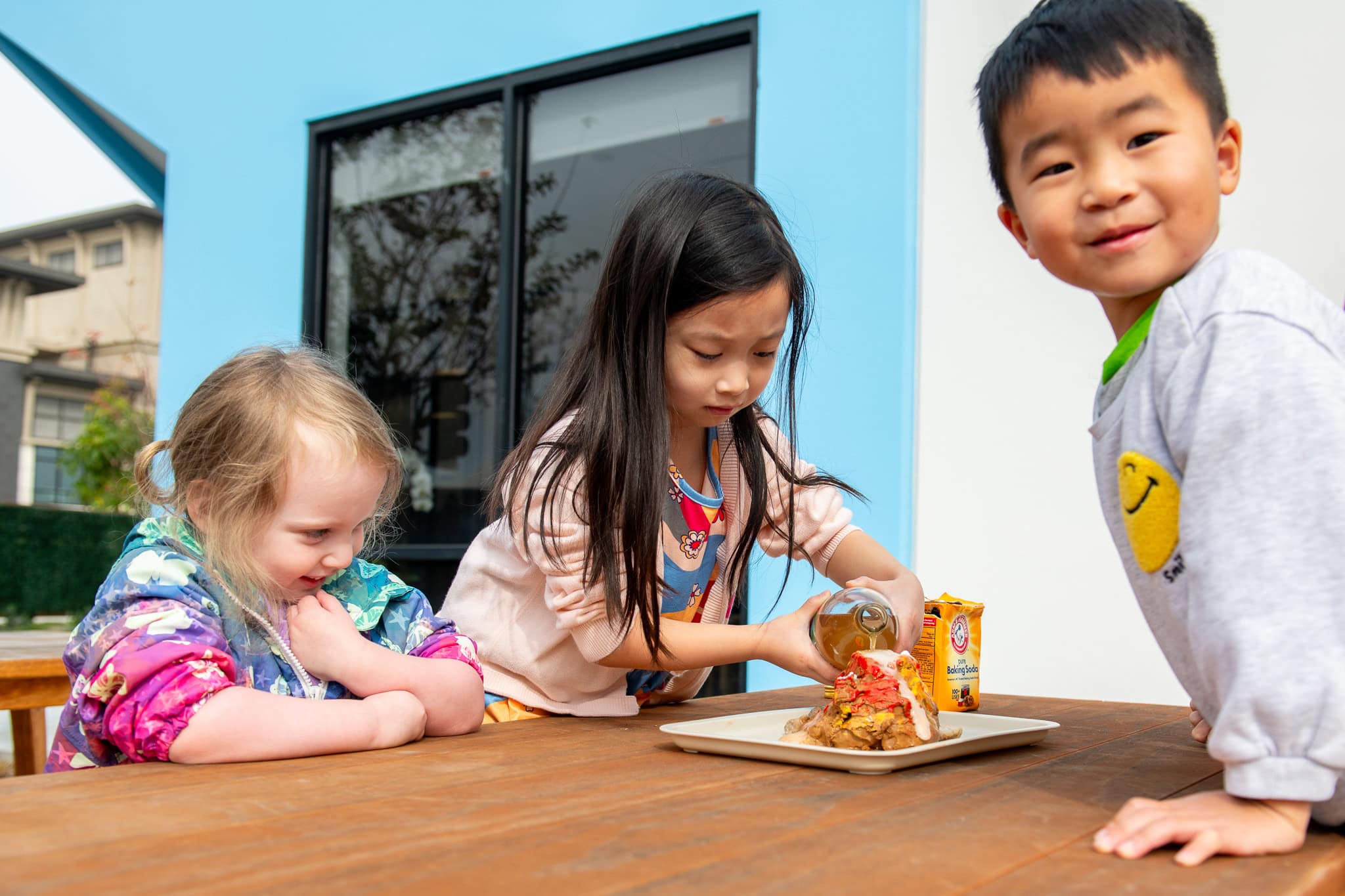
The Mind of the Toddler: How Montessori Builds Early Engineering, Spatial Reasoning, and Problem-Solving Skills
If you’ve ever watched your toddler stack blocks with intense concentration, build elaborate ramps for toy cars, carry furniture across the room, or attempt to “fix” a broken object with confidence, you may have wondered:
Is my child an engineer?
From a Montessori perspective, the answer is yes.
What looks like simple play is actually the development of spatial reasoning, logical thinking, and problem-solving—the foundational skills behind engineering, architecture, mathematics, and scientific thinking.
Toddler Play Is Early STEM Learning
In the Montessori early years, learning is not delivered through worksheets or screens. Instead, it unfolds through purposeful movement, hands-on exploration, and self-directed discovery.
Dr. Maria Montessori observed that young children experience sensitive periods—windows of heightened brain development when certain skills are acquired with remarkable ease. During the toddler years, the brain is especially receptive to:
- Spatial awareness
- Cause-and-effect reasoning
- Sequencing and planning
- Problem-solving through trial and error
In other words, toddlers are biologically wired to explore how the world works.
The Child’s Natural Drive to Build Understanding
When a toddler:
- Fits shapes into a puzzle
- Balances blocks into towers
- Figures out how to open, close, pour, carry, or assemble
- Tests what happens when something falls, rolls, or stacks
They are doing far more than playing.
They are developing engineering thinking—learning how objects relate in space, how actions produce outcomes, and how to adjust strategies when something doesn’t work.
These skills are interconnected. Together, they form the foundation for higher-level STEM learning later in childhood.
Montessori Materials as Early Engineering Tools
In a Montessori classroom, materials are intentionally designed to support problem-solving and independent thinking.
Practical Life Activities
Pouring, spooning, transferring, opening and closing, and carrying strengthen:
- Executive function
- Sequencing and planning
- Precision of movement
- Focus and self-regulation
Cause-and-Effect Exploration
Materials that respond to a child’s actions teach a foundational scientific principle:
Choices create outcomes.
Sensorial Learning
Working with varied textures, weights, sounds, and dimensions refines:
- Observation
- Discrimination
- Sensory processing
Gross Motor Problem-Solving
Climbing, pushing, pulling, and navigating space build:
- Spatial reasoning
- Body awareness
- Early engineering and physics concepts
At this stage, learning is not about perfection—it is about understanding systems.
Why Early Spatial Reasoning Matters Long-Term
Research in developmental psychology consistently shows that early spatial reasoning skills are strong predictors of later success in math, science, and engineering.
Montessori education supports this development at the exact moment the brain is most receptive—without pressure or premature academics.
Just as importantly, children learn that:
- Problems are invitations to think
- Mistakes are part of learning
- Persistence leads to discovery
These are lifelong skills, not just academic ones.
How Parents Can Support the Young Engineer at Home
Families can nurture this development with simple, intentional choices:
- Offer blocks, puzzles, and open-ended construction materials
- Invite children to participate in real tasks like pouring, building, and assembling
- Pause before solving problems—allow time for thinking
Use language that honors effort:
“You’re working hard on that. What do you think will happen next?”
Confidence grows when children feel trusted in their ability to think.
The Engineer’s Mind Begins in Early Childhood
In Montessori, we don’t rush academics—we build the mind that will master them.
Long before math equations or science experiments appear on paper, the young child is constructing the internal architecture required for deep understanding.
So when you watch your toddler quietly building, testing, adjusting, and trying again, you are witnessing something extraordinary.
You are watching the early work of an engineer.
Montessori and Early STEM Learning at WELA
At Westcliff Early Learning Academy in Irvine, we see this process unfold every day. Our Montessori–Reggio inspired program integrates early STEM and STEAM foundations through hands-on, child-led exploration, supporting children ages 18 months to 6 years as they grow into confident, curious thinkers.
Because the future doesn’t just belong to children who know answers—it belongs to children who know how to think.
